
Time to recap – International Coastal Clean-up 2024
The International Coastal Cleanup (ICC) is a global initiative where volunteers gather to remove litter from beaches, rivers, and lakes. Established in 1986 by Ocean Conservancy, the ICC is now the world’s largest volunteer-driven effort to combat ocean pollution. Held annually on the third Saturday of September, the event spans multiple countries across the globe. While final participation numbers for 2024 are still being compiled, in 2023, 118 countries took part in the cleanup.
South Africa has been involved in the ICC for over 25 years. In 1997, Plastics|SA, in partnership with Ezemvelo KZN Wildlife, collaborated with Ocean Conservancy to bring the ICC to South Africa, with a focus on addressing the growing issue of plastic pollution in the country’s coastal areas. In 2000, Plastics|SA expanded the initiative by teaming up with various stakeholders to launch “Cleanup and Recycle Week SA”, further extending the impact of the event.
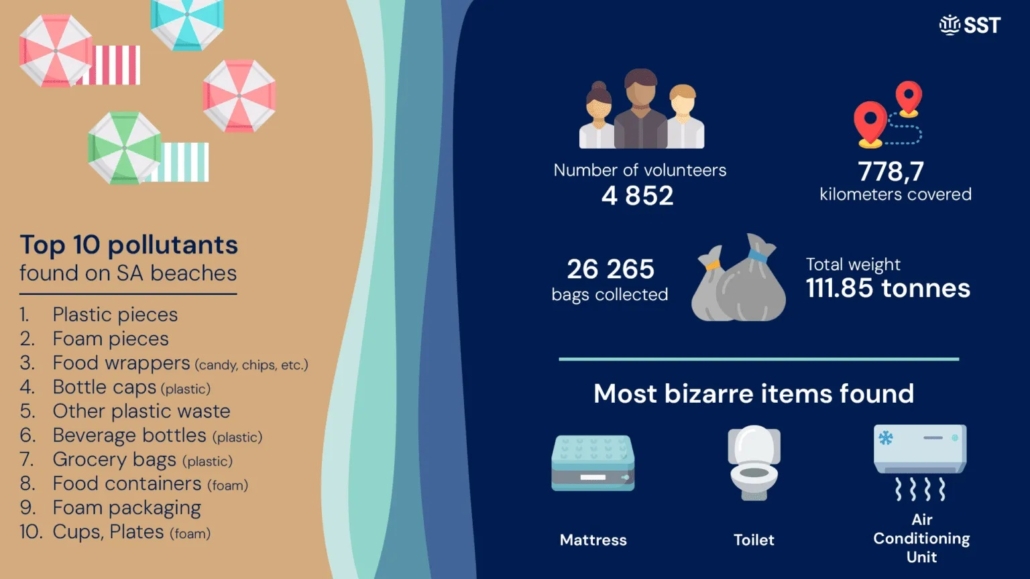
Historically, data collection during South Africa’s clean-ups has been limited, reflecting the overall scarcity of information on local clean-up efforts. In 2023, SST joined forces with Plastics|SA to enhance the coordination of ICC activities through Operation Clean Spot (OCS). Launched in 2021, OCS is a citizen science project aimed at reducing land-based litter in South Africa and across Africa while collecting valuable environmental data. The ICC’s goals align directly with OCS’s mission, making the partnership a natural fit.
The first year of collaboration revealed a troubling reality: many clean-ups in South Africa were occurring without proper reporting. These clean-ups, primarily organised by volunteers and non-profit organisations operating on tight budgets, often lack sufficient support. While Plastics|SA and other sponsors provide materials like bags and equipment when possible, additional support is crucial to sustain and expand these efforts.
In 2024, SST took proactive steps to promote data collection, delivering several public presentations on both the ICC and OCS. These efforts encouraged more accurate reporting and helped foster better communication with clean-up organisers. As a result, there was a noticeable increase in the amount of data collected during the ICC, which will play a vital role in shaping future cleanup initiatives.
We extend a gratitude to all the clean-up hosts and volunteers, for the extensive clean-up efforts. We are also grateful to Plastics|SA and the other sponsors for supporting the clean-up initiatives with bags. We would like to encourage all businesses to support their local clean-ups in the 2025 clean-up and recycle season.
This article was provided by SST.

